March 29, 2021

Do We Want To Perform Or To Learn? Is There A Difference?

This post intends to provide guidance for parents as to what to expect and pursue in the developmental stages of their children throughout youth soccer.

Empathy  is one of Rush Soccer’s core values, and we believe it requires little empathy to understand parents’ love for their children and their desire to stay involved. That doesn’t mean, with all due respect, that parents know exactly  how  to be involved and what they should expect from their children’s experience along youth soccer.

Many times, we take winning as a measuring stick.  If the team wins, it means we are doing something right, correct?  No, it actually does not mean we are doing anything right. Soccer is the only sport in which you can do everything wrong and still win.  Competing to win  is a different story. Competing to win is not only desirable, but natural, everybody competes with the desire to win, but  winning  itself can be a misleading parameter when we talk about youth soccer. Let me explain why.

The first thing that we need to cover is that  the objective of youth sports is not to win but to develop better players and better people.  Like Ruben Rossi, one of the most renowned youth soccer developers in the world told us a few weeks ago:

In youth soccer, winning is never an objective, it is a reward  – Ruben Rossi

The reason behind this statement relies on understanding the difference between  Performance  and  Learning. Quoting Nick Soderstrom (Ph.D. in cognitive psychology):

Learning refers to relatively permanent changes in knowledge or behavior. It is — or at least should be — the goal of education. Performance, on the other hand, refers to temporary fluctuations in knowledge or behavior that can be measured or observed during (or shortly after) instruction.  – Nick Soderstrom

Or using a passage from an interview we conducted with John O’Sullivan:

“You cannot recognize learning in the moment. This is performance.  Learning is being able to retrieve the information and skill over time.  Learning happens over time. Many parents (and coaches) confuse performance for learning”.  – John O’Sullivan

Let me translate this onto a (pretty bad) example that you’ll easily relate to. If I told (as a coach) your son/daughter ‘Johnny/Susie, when you get the ball off of a throw in, turn and play a long switch to the other side’, they will surely do it and maybe it would even be effective for the team, but has any learning taken place?

Imagine now that instead of saying that, I would have referred to the situation as follows: ‘Johnny/Susie, as we play I want you to think about attacking throw ins, what do you notice about the playing space? Don’t tell me now, let’s chat about it at the end of this activity’. Now Johnnie or Susie will return 30 minutes later, after an extensive thought process, possibly with an answer of the type ‘Coach, the space gets crowded, there’s not a lot of space to play’, to which I could continue to guide by saying ‘That’s correct. Now.. we know that the field is always the same size, so if it’s crowded in one area, what’s that telling you about the others?’.

As you can see, now Johnnie or Susie are reaching the conclusion that switching sides immediately can be a solution during offensive throw ins, but the process was a lot slower, yet there’s learning taking place, they’re building their game understanding, what will generate not only transference to other game situations, but also, as John O’Sullivan mentioned, they will be able to  retrieve  the information in the future.

That’s why the main objective of a youth club is to develop players, not to win, because the focus should be to help players learn.

Here, in fact, is a video from Dr. Bjork (who Nick S. will cite later on) explaining this process.

Always keep the eye in the long term vision. I’d sacrifice all the gold medals at U9 and U10 if I knew we are doing everything to see my child’s top potential at U19.

Moreover, I’ll give you a tip:  Worry if your children are winning too much, because if they are, that probably means they’re not being challenged at the level they should be, and that limits their development. 

That’s why at Rush Soccer we have a policy that we call ‘6-3-1’, that is a desired record for a team along a season: 6 wins, 3 loses, 1 tie. We use it as a measuring stick to set an appropriate level of challenge for the players to be exposed to.

Hang on… Are you telling me that you want them to fail, to lose?  Yes, we are.

I’ll wrap it up with one more passage from Nick Soderstrom, look how interesting this is:

There’s no doubt that performance gains can fail to support learning gains. As my initial example illustrated, progress during a lesson can be misleading in terms of what has been retained and can fool teachers and students alike. This is especially true if the performance gains are achieved by using teaching strategies that are designed to produce rapid progress. For example, doing the same type of problem repeatedly in class can lead to rapid, yet fleeting, gains in short-term performance.

But what about the flip side? If increased performance can lead to decreased learning, can decreased performance lead to increased learning? The answer is ‘yes.’ As counterintuitive as it sounds, long-term learning can be enhanced by intentionally impairing short-term performance.

The learning strategies that fall under this category are called desirable difficulties (Bjork, 1994). They are desirable because they lead to better long-term retention and transfer of knowledge, and they are difficult because they pose challenges that slow the rate of current progress and induce more mistakes during instruction or training.

In a nutshell, the concept of desirable difficulties embodies the adage: no pain, no gain. Just like how taking the stairs is better for our health than taking the escalator, making learning more challenging can lead to better retention.

This sounds simple but has profound implications in the way clubs and coaches approach the work, and I think this is very important because you as a parent should demand this from your club.

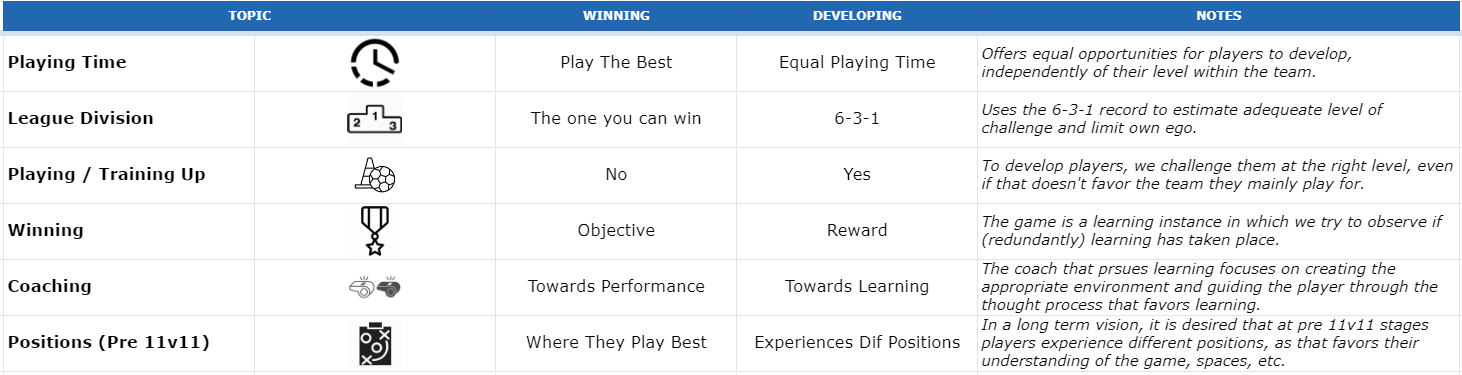
I’ve had this conversation with parents several times, so trying to find good examples I came up with what I call the ‘winning vs developing chart’ (said as an equivalent of performance vs learning approach). This chart offers concrete, visual differences between coaching for learning versus coaching for development.

I’m sharing it with you because, once again, I actually hope you hold your club and coach accountable for this. Check below.
By Ubaldo Murillo • October 2, 2026
Frank Meza Named East Penn Rush Director of Player Development
By Ubaldo Murillo • September 30, 2026
East Penn Rush is excited to expand our competitive opportunities through participation in the Atlantic Premier League (APL)/Acela , providing several of our younger Premier and Elite teams with another high-level environment for competition and player development. The Atlantic Premier League offers competition for boys and girls beginning at the younger age groups and features multiple levels of play. For the 2026–27 season, APL offers an Acela First Division along with a second division, creating opportunities for clubs to place teams at an appropriate competitive level. For East Penn Rush, joining APL/Acela is particularly important for our Premier and Elite teams below the U13 age groups . While many national-level leagues and pathways begin at U13, APL/Acela gives our younger players an opportunity to experience a highly competitive regional environment earlier in their development. Competing Against High-Level Programs One of the biggest benefits of APL/Acela is the level and variety of competition available throughout the region. The league attracts competitive programs from Pennsylvania, New Jersey, Delaware, Maryland and surrounding areas. APL/Acela competition has included teams associated with Pre-MLS NEXT, Pre-Academy and other high-level developmental programs . Published league results, for example, show APL/Acela competition involving teams such as FC DELCO Pre-MLS NEXT, Keystone FC Pre-Academy, Philadelphia Union Juniors, Real Futbol Academy and other strong regional programs. This gives our younger Rush teams an opportunity to regularly challenge themselves against different playing styles, stronger competition and organizations with established academy pathways. Building the Pathway Before U13 Our goal is not simply to enter teams into another league. The addition of APL/Acela is part of the continued development of the East Penn Rush player pathway . For our younger Premier and Elite players, the U9–U12 years are critical developmental stages. Players are learning how to apply their technical ability in increasingly faster and more demanding game environments. Playing against quality opposition requires players to make decisions quicker, become more comfortable under pressure and develop a deeper understanding of the game. APL/Acela gives us another platform to challenge those players before they reach U13 , when additional regional and national opportunities become available. The pathway is designed to progressively prepare players for the next level: East Penn Rush Development → Competitive Travel → Elite/Premier → APL/Acela → U13+ Regional & National Opportunities For players who continue progressing through the club, this experience can help prepare them for the competitive demands they will encounter as they move toward our older Premier teams and opportunities such as the National 1 (N1) League . More Opportunities. More Competition. More Development. East Penn Rush continues to build an environment where players do not have to wait until their teenage years to experience meaningful, high-level competition. Adding multiple teams to APL/Acela allows us to better match our Premier and Elite teams with competition that challenges them at the appropriate stage of their development. It also expands the range of opponents our teams can face beyond traditional local league play. Our objective remains the same: put players in environments that challenge them, support their development and prepare them for the next step in their soccer journey. Participation in APL/Acela represents another important step forward for East Penn Rush and our commitment to creating a complete developmental pathway from our youngest players through our Premier and national-level teams. One Club. One Pathway. More Opportunities.
By Ubaldo Murillo • September 29, 2026
East Penn Rush Accepted into the National 1 League
Show More